Pengboxingchen Editorial Team ·
After Heavy Rain: Recording and Resolving Water Entry in Modular Buildings
A ground-level observation guide for recording water entry in modular buildings after heavy rain — distinguishing condensation from ingress, documenting timing and interfaces, protecting occupants and equipment, and managing professional investigation and verified repair closeout.
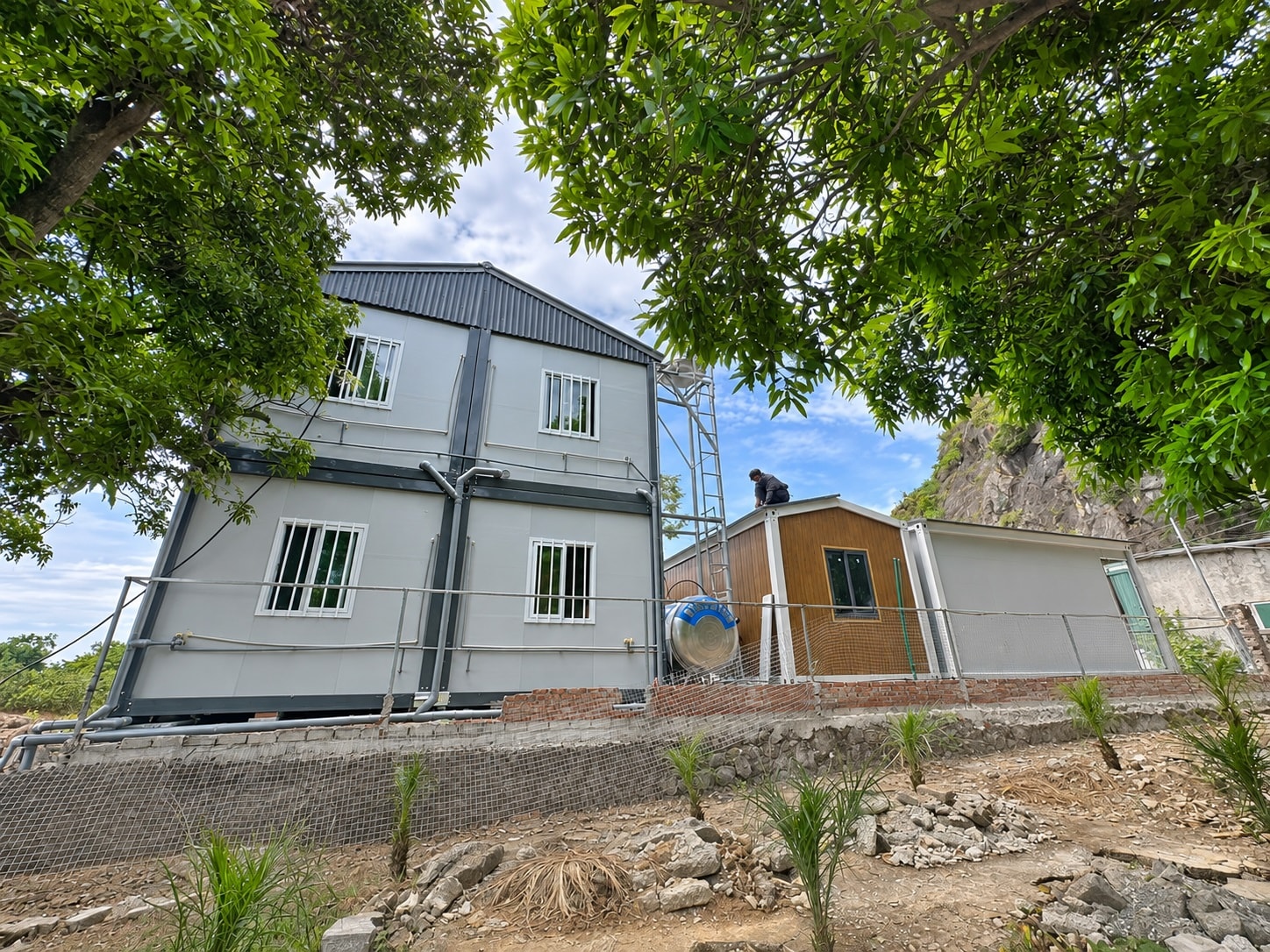
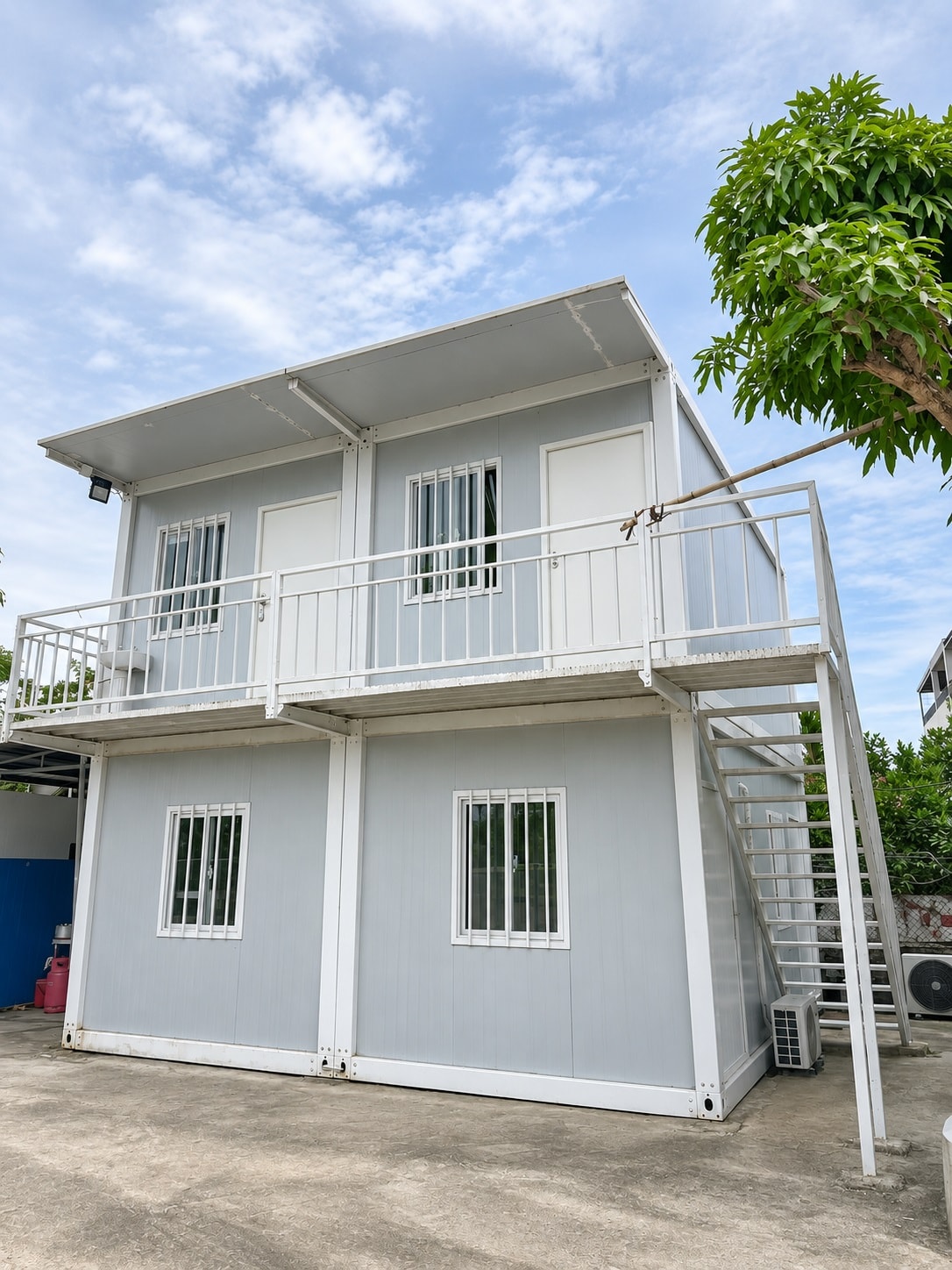
This article is a practical observation and documentation guide. It does not provide waterproofing engineering guidance or remote diagnosis of water entry sources. Water entry in a building requires investigation by a qualified building inspector or waterproofing specialist. Do not climb onto roofs, access elevated areas without appropriate equipment and training, or carry out electrical work in response to water entry. The photograph shows a two-storey modular cabin exterior; it does not confirm the presence or absence of water entry in any building.
The Value of Systematic Post-Rain Observation
Heavy rain is the most reliable test of a modular building's envelope performance. A building that performs well in dry conditions may reveal water entry paths during or after a significant rain event — at sealant joints that have begun to debond, at flashings that were not correctly lapped, at window frames where the drainage path is blocked, or at the junction between the building and its foundation. Systematic observation after heavy rain, recorded consistently over time, builds a picture of the building's performance that is more useful than a single inspection.
The WBDG Whole Building Design Guide's moisture management guidance notes that moisture entry, drainage and drying must be considered together — a principle that applies to post-rain observation as much as to initial design. An observation that records not just the location of water but also the weather conditions, the timing relative to the rain event, and the specific interface where water appears gives the investigating professional the information they need to identify the source efficiently.
Safe Ground-Level Observations
Post-rain observations should be made from ground level, from inside the building, and from any accessible balconies or platforms that can be reached safely without climbing. Do not climb onto the roof, lean out of upper-floor windows, or access elevated areas without appropriate equipment, training and, where required, a permit to work at height. The information needed for a professional investigation can be gathered from ground level; the investigation itself — which may require roof access or opening up of wall panels — is the professional's responsibility.
From ground level, observe: the external wall surfaces for water staining, streaking or wet patches; the window and door frames for water at the sill or frame junction; the base of the building for water pooling or wet ground that may indicate drainage problems; and the visible roof edges and gutters for overflow or blockage. From inside the building, observe: the ceiling and upper wall surfaces for water staining, wet patches or drips; the window reveals for condensation or water at the frame; and the floor near external walls for wet patches.
Distinguishing Condensation from Wind-Driven Rain and Plumbing Leaks
Not all water observed inside a building after rain is water entry through the envelope. Condensation — water vapour from the air condensing on cold surfaces — can produce wet patches on windows, walls and ceilings that are easily mistaken for water entry. Condensation typically appears on the coldest surfaces in the room (glass, metal frames, uninsulated wall areas) and is more common in cold weather or when the building is occupied after a period of being unoccupied. It typically dries as the building warms up and does not recur in the same location after every rain event.
Wind-driven rain entry typically appears during or immediately after a rain event with significant wind, at specific interfaces — window frames, door thresholds, wall-to-roof junctions — and recurs at the same location in similar weather conditions. Plumbing leaks are not weather-dependent and may appear at any time; they are typically associated with a specific fixture or pipe route. Record the timing and weather conditions for each observation to help distinguish these sources.
Recording Timing, Weather and Exact Interface
A useful water entry record includes: the date and time of the observation; the weather conditions at the time (rainfall intensity, wind direction and speed if known); the time elapsed since the rain event began; the exact location of the water (which room, which wall, which height, which interface); a description of the water (drip, wet patch, staining, running water); and a photograph. The photograph should show the water and its location clearly, with a reference object for scale if possible.
Record the same information at subsequent observations — whether the water has dried, whether it has recurred, and whether the pattern has changed. A water entry that recurs at the same location in the same weather conditions is a consistent envelope defect; one that appears once and does not recur may be a one-off event caused by an unusual combination of conditions. The pattern of recurrence is important information for the investigating professional.
Protecting Occupants and Equipment
While water entry is being investigated and repaired, protect occupants and equipment from the immediate effects. Move equipment away from wet areas. Place containers to catch drips if the source cannot be immediately stopped. If water is near electrical equipment, isolate the electrical circuit before touching the equipment — do not attempt to operate electrical equipment that has been wetted. If the water entry is significant or the source is unknown, consider whether the affected area should be vacated until the investigation is complete.
Do not attempt to seal water entry points with tape, sealant or other temporary materials without understanding the source. Sealing over a water entry point without addressing the cause can trap moisture within the construction, leading to concealed deterioration that is more difficult and expensive to repair than the original entry point.
Professional Investigation and Verified Repair Closeout
Water entry that recurs, that is significant in volume, or that cannot be attributed to a known cause should be investigated by a qualified building inspector or waterproofing specialist. Provide the investigator with the observation records — the dates, weather conditions, locations and photographs — before the inspection. This information allows the investigator to focus on the most likely sources and to plan the investigation efficiently.
After a repair is carried out, verify that the repair has resolved the water entry by observing the building through at least one subsequent rain event of similar intensity to the event that revealed the problem. Record the post-repair observations in the maintenance log. A repair that has not been verified through a subsequent rain event has not been confirmed as effective. See also our articles on modular cabin maintenance log and modular cabin roof drainage brief.
Post-Rain Observation Checklist
- Observe from ground level and accessible interior only — do not climb onto roofs
- Check external walls for water staining, streaking or wet patches
- Check window and door frames for water at sill or frame junction
- Check base of building for water pooling or wet ground
- Check ceiling and upper walls inside for staining, wet patches or drips
- Record date, time, weather conditions and time elapsed since rain began
- Record exact location, description and photograph of each observation
- Distinguish condensation (cold surfaces, dries quickly) from rain entry (recurs at same location in rain)
- Isolate electrical circuits near wet areas before touching equipment
- Escalate recurring or significant water entry to a qualified inspector
- Verify repair effectiveness through a subsequent rain event and record the result
Frequently Asked Questions
How do I know if water entry is covered by the manufacturer's warranty?
Warranty coverage depends on the contract terms and the cause of the water entry. Water entry caused by a manufacturing defect — incorrect flashing installation, inadequate sealant application, a panel that was not correctly fixed — is typically covered. Water entry caused by damage, unauthorised alteration, or failure to maintain the building as required by the manufacturer's documentation is typically not covered. Document the observation and contact the manufacturer with the records; do not carry out repairs that might affect the warranty position without the manufacturer's agreement.
What if the water entry is at the junction between the building and the site drainage?
Water entry at the building-to-site junction — at the base of the wall, at the threshold, or at the connection between the downpipe and the ground drainage — is typically a site responsibility rather than a manufacturing defect. Confirm the responsibility allocation from the contract and the handover documentation. For enquiries about drainage coordination, see our article on modular cabin roof drainage brief or contact our team.
Topics
Explore our modular room products
Ready to discuss your project?
Our team is available to answer technical questions and provide indicative pricing for your modular construction project.
Contact Us