Pengboxingchen Editorial Team ·
Modular Building Windows: Operation, Cleaning and Replacement Planning
A practical guide to operating, cleaning and planning replacement of windows in modular buildings — covering operating modes, hardware checks, gasket condition, drainage-path care, safe cleaning strategy, replacement access and product identification.
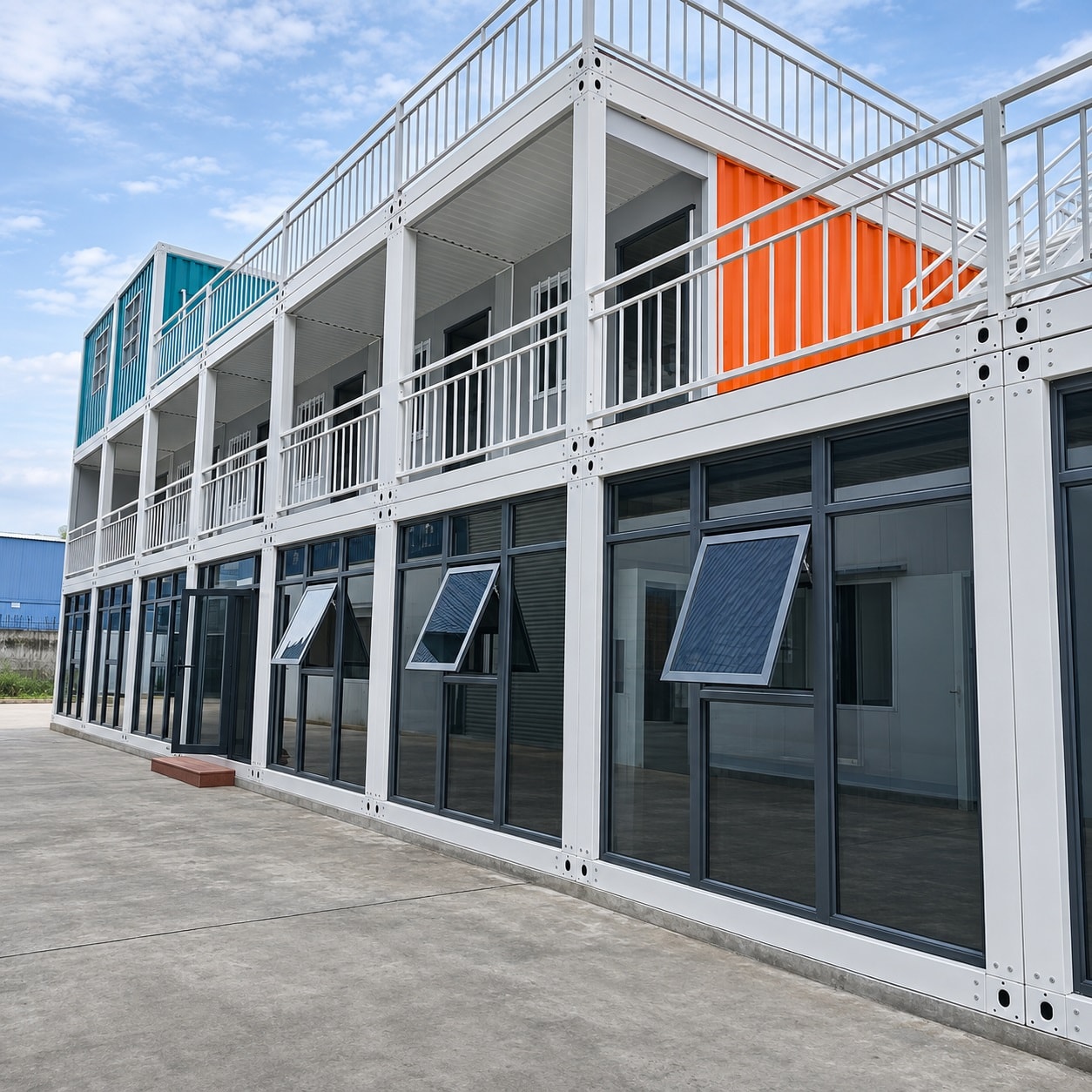
This article is a practical operation and maintenance guide for modular building windows. It does not provide glazing engineering guidance, thermal performance data, or compliance guidance for any specific application. Glazing performance — U-values, solar heat gain, acoustic performance — depends on the specific product and installation; do not infer performance from the appearance of a window. Cleaning and maintenance at height requires appropriate access equipment and training; this article covers ground-level checks only. The photograph shows a two-storey modular building with a glazed facade and awning windows; it does not confirm the glazing specification or performance of any building.
Understanding the Operating Modes in Your Building
Modular buildings use a range of window types — fixed lights, casement windows, awning windows, sliding windows, tilt-and-turn windows, and louvred windows — often in combination on the same facade. Each type has a different operating mechanism and different maintenance requirements. Before carrying out any maintenance, confirm the window types installed in the building from the manufacturer's drawings or the handover documentation. Operating a window incorrectly — for example, forcing a tilt-and-turn window into a position it is not designed for, or opening an awning window beyond its designed opening angle — can damage the hardware and void the warranty.
The photograph illustrates a building with awning windows (the outward-opening panels visible in the lower level) and large sliding or fixed glazed panels. Awning windows are hinged at the top and open outward at the bottom; they provide ventilation while offering some protection from rain. Confirm the maximum opening angle from the manufacturer's documentation and do not exceed it. Sliding windows require the track to be kept clean and free of debris for smooth operation.
Hardware Checks: Hinges, Locks, Handles and Stays
Window hardware — hinges, friction stays, espagnolette locks, handles and restrictors — is subject to wear and to corrosion in humid, coastal or industrial environments. Carry out a hardware check at each maintenance inspection: open and close each operable window and confirm that it operates smoothly without binding, sticking or requiring excessive force; confirm that the lock engages fully and that the window is secure when locked; confirm that the friction stay holds the window in the open position without the window dropping or swinging; and confirm that the handle operates the lock mechanism correctly without excessive play.
Record any hardware that is stiff, binding, corroded or not operating correctly. Stiff or binding hardware is often an early indicator of frame distortion or settlement; record the observation and monitor it at subsequent inspections. Do not apply lubricants to window hardware without confirming the correct lubricant with the manufacturer — an incompatible lubricant can damage seals and attract dust. Confirm the recommended lubricant type and application method from the manufacturer's documentation.
Gasket and Seal Condition
The weathertightness of a window depends on the condition of the gaskets and seals — the rubber or EPDM strips that compress between the frame and the sash, and between the frame and the wall panel. Inspect the gaskets at each maintenance inspection: confirm that they are intact, that they are compressing correctly when the window is closed, and that there are no areas of cracking, splitting, hardening or debonding. A gasket that is not compressing correctly — because it has hardened, because the frame has distorted, or because the hardware is not pulling the sash tight — will allow water and air to pass around the window.
Sealant at the junction between the window frame and the wall panel is a separate element from the gasket. Inspect the external sealant at each maintenance inspection and record any areas of cracking, splitting or debonding. Sealant repairs should use a product that is compatible with the existing sealant and with the frame and panel materials; confirm the product with the manufacturer before carrying out repairs. See also our article on modular cabin maintenance log for a general framework for recording these observations.
Drainage Path Care
Window frames include drainage paths — small slots or holes in the frame that allow water that enters the rebate to drain out rather than accumulating and causing damage. These drainage paths can become blocked by dust, debris, paint or sealant applied during maintenance. Inspect the drainage paths at each maintenance inspection and confirm that they are clear. A blocked drainage path can cause water to accumulate in the frame, leading to corrosion of metal frames, swelling of timber frames, or water entry into the wall panel.
The drainage path from the window sill to the external face of the building must also be clear. A sill that is not sloped away from the building, or a sill drainage slot that is blocked, will cause water to pond on the sill and eventually enter the building at the frame-to-panel junction. Confirm the sill drainage detail from the manufacturer's drawings and check that it is functioning correctly at each inspection.
Safe Cleaning Strategy
Window cleaning in a modular building should be planned as part of the maintenance programme, not carried out on an ad hoc basis. Ground-floor windows can typically be cleaned from ground level using a squeegee and extension pole. Upper-floor windows require access equipment — a mobile elevated work platform, a scaffold platform, or a rope access system — and the cleaning method must be appropriate for the access equipment used. Do not lean out of upper-floor windows or stand on window sills to clean external glass; this is unsafe and can damage the window hardware.
Confirm the cleaning method with the manufacturer before using pressure washing on window frames. High-pressure water can force water past gaskets and seals, damage frame coatings, and dislodge sealant. If pressure washing is used, confirm the maximum pressure and the minimum distance from the frame with the manufacturer. For most modular building window frames, hand washing with a mild detergent and a soft cloth or sponge is the recommended method.
Replacement Access and Product Identification
Windows in a modular building will eventually need to be replaced — due to damage, hardware failure, or the end of the product's service life. Planning for replacement before it is needed avoids delays and cost overruns when replacement becomes necessary. Confirm from the manufacturer's documentation: the make and model of each window type installed in the building; the glass specification (thickness, type, coating) for each window; the hardware make and model for each window type; and the supplier contact details for spare parts and replacement units.
Confirm also how replacement windows will be installed. A ground-floor window can typically be replaced from outside the building. An upper-floor window may require internal access, external access equipment, or both. If the window is set into a structural panel, replacement may require the manufacturer's involvement to avoid damaging the panel. Confirm the replacement procedure with the manufacturer before a replacement is needed, not after.
Window Maintenance Checklist
- Confirm window types and operating modes from manufacturer's drawings
- Open and close each operable window; confirm smooth operation without binding
- Confirm lock engages fully and friction stay holds window in open position
- Inspect gaskets for cracking, splitting, hardening or debonding
- Inspect external sealant at frame-to-panel junction for cracking or debonding
- Confirm drainage paths in frame and sill are clear of debris
- Confirm sill is sloped away from building and sill drainage slot is clear
- Plan window cleaning using appropriate access equipment for each level
- Confirm cleaning method with manufacturer before using pressure washing
- Record make, model and glass specification for each window type
- Confirm replacement procedure with manufacturer before replacement is needed
Frequently Asked Questions
How do I know if a window needs to be replaced rather than repaired?
Hardware failure — broken hinges, failed locks, worn friction stays — can usually be repaired by replacing the hardware component, provided the replacement part is available. Frame damage — corrosion, distortion, cracking — may require frame replacement. Glazing failure — broken glass, failed double-glazing seal (indicated by condensation between the panes) — requires glass replacement. Confirm the repair or replacement option with the manufacturer or a qualified window contractor before ordering parts.
Can I replace a window with a different type or size?
Replacing a window with a different type or size is an alteration to the building envelope and requires the same review process as any other alteration — confirm with the manufacturer that the proposed change is structurally acceptable and that it does not affect the building's thermal or acoustic performance. See our article on changing a modular building for the general change review process. For enquiries about window specifications and configurations, see our products page or contact our team.
Topics
Explore our modular room products
Ready to discuss your project?
Our team is available to answer technical questions and provide indicative pricing for your modular construction project.
Contact Us