Pengboxingchen Editorial Team ·
Before Delivery: Surveying Gates, Turning Space and Site Access
A focused guide to surveying the delivery route for a modular cabin — identifying bottlenecks, overhead obstructions, ground restrictions, utility crossings, staging areas and pedestrian segregation before the vehicle arrives.
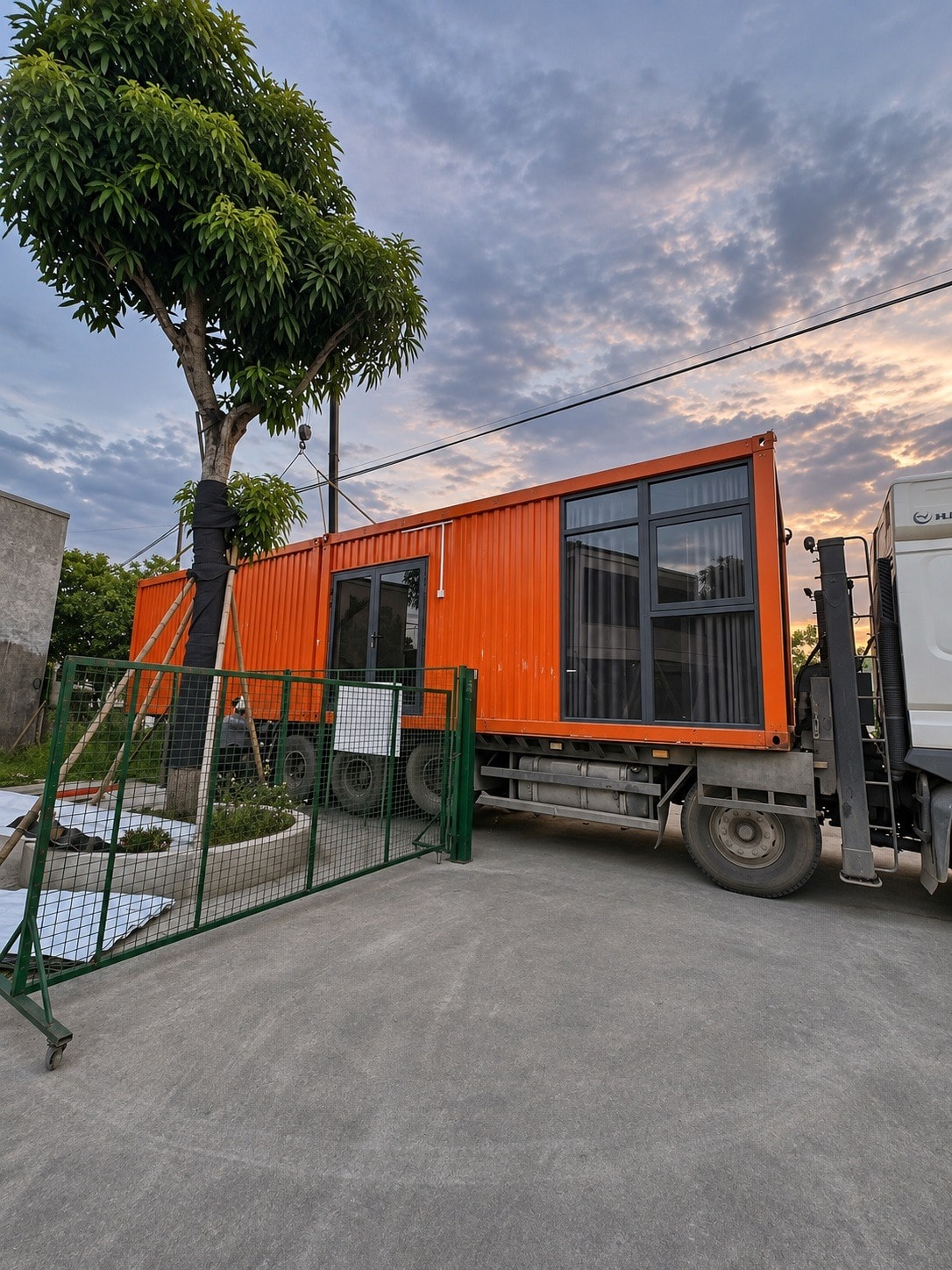
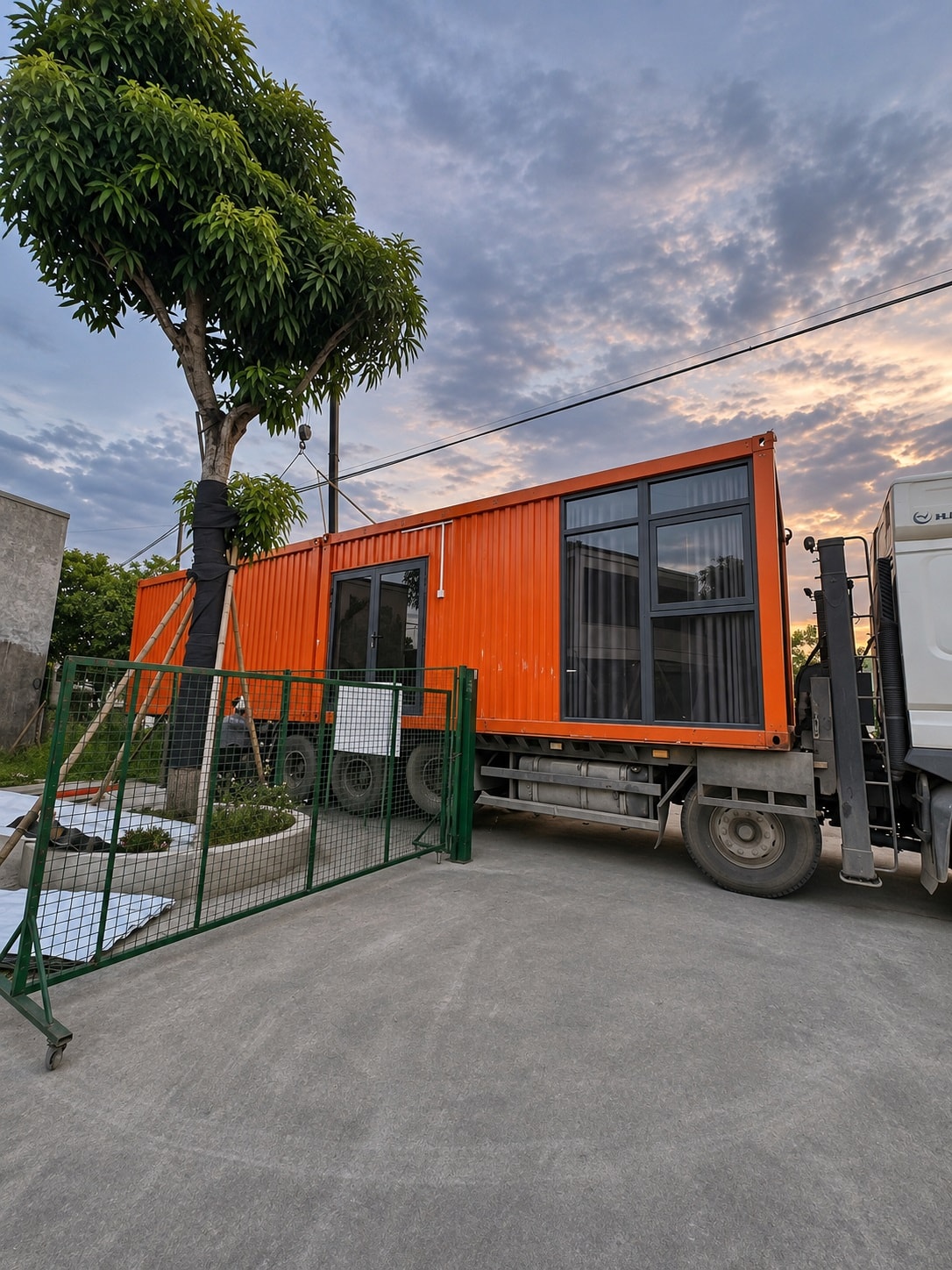
This article covers pre-delivery route and site access surveying. It does not cover crane operations, lifting plans, structural load calculations or traffic management schemes, which require qualified professional input. The photograph shows a modular unit on a delivery vehicle near a gate; it does not represent an approved delivery operation or confirm that the access shown is adequate for any specific vehicle or load.
The Purpose of a Pre-Delivery Access Survey
A modular cabin arrives on a vehicle that is significantly larger than the cabin itself. The vehicle — typically a flatbed truck or low-loader — has a fixed wheelbase, a turning radius, and a combined length and height that must be accommodated at every point on the route from the factory gate to the installation position. A route that looks straightforward on a map can contain bottlenecks that are only visible on the ground: a gate that is narrower than it appears, a tree branch that reduces the effective height clearance, a utility cover that cannot support the vehicle's axle load, or a bend that the vehicle cannot negotiate without mounting a kerb.
The purpose of the pre-delivery survey is to identify these constraints before the vehicle arrives, not after it is stuck. A failed delivery attempt wastes the carrier's time and the buyer's money, and can cause damage to the vehicle, the cabin, the site or adjacent property. A survey carried out with the exact vehicle and load dimensions in hand takes a few hours and can prevent a day of disruption.
Obtain Exact Vehicle and Load Dimensions First
Do not survey the route until you have the exact vehicle and load dimensions from the carrier. The relevant dimensions are: overall vehicle length (including tractor unit and trailer); overall vehicle width; overall height with the cabin loaded; trailer bed height (which determines the height of the cabin's lowest point above the road surface); and the vehicle's minimum turning radius. These dimensions vary between carriers and between vehicle types; do not assume standard dimensions. Ask the carrier to confirm them in writing before the survey.
The cabin dimensions — length, width and height — should be confirmed from the manufacturer's drawings, not from the order summary. A cabin with a pitched roof will be taller than a flat-roof unit of the same nominal size. Confirm whether the cabin is transported on its base frame or on additional dunnage, as this affects the loaded height.
Identifying Route Bottlenecks
Walk or drive the complete route from the nearest main road to the installation position, looking for the following constraints. Width restrictions: gates, gateposts, walls, parked vehicles, and narrow road sections. Measure the clear width at each restriction and compare it with the vehicle width plus a working margin (the carrier will advise on the minimum margin they require). Height restrictions: overhead cables, tree branches, bridge soffits, canopies and signs. Measure the clear height at each restriction and compare it with the loaded vehicle height. Overhead utility cables are a particular hazard — contact the utility operator if there is any doubt about the clearance. Turning constraints: junctions, bends and gateways where the vehicle must turn. The vehicle's turning radius determines the minimum road width and the swept path through a turn; the carrier can provide a turning template if required.
Ground and Bridge Load Restrictions
The delivery vehicle's axle loads may exceed the capacity of soft ground, utility covers, private roads and bridges. Check: whether the route includes any private roads or bridges with posted weight limits; whether there are utility covers (manholes, inspection chambers, cable ducts) in the vehicle's path that may not support the axle load; and whether the ground at the installation position is firm enough to support the vehicle during unloading. If there is any doubt about ground bearing capacity, obtain a ground investigation report or consult a structural engineer before the delivery.
Utility covers in the vehicle's path can be bridged with steel plates if the carrier is informed in advance. Do not assume the carrier will bring bridging plates without being asked. See also our article on modular transport and installation planning for broader installation coordination questions.
Utility Crossings and Underground Services
The installation position and the vehicle's approach path may cross underground services — water mains, gas pipes, electricity cables, drainage pipes, telecoms ducts. The vehicle's weight can damage shallow services if they are not identified and protected. Before the delivery, obtain a utility search for the site and the approach path, and mark any services that are within the vehicle's wheel track. If services are present, confirm with the relevant utility operators whether bridging or temporary protection is required.
Staging Area and Unloading Position
The vehicle needs a staging area — a level, firm area large enough for the vehicle to park while the cabin is unloaded. The staging area must be accessible without the vehicle reversing over a long distance, and it must be clear of overhead obstructions during unloading. Confirm the staging area dimensions with the carrier before the delivery. If the cabin is to be placed by crane, the crane position and its outrigger footprint must also be confirmed — this is a separate operation requiring a lifting plan prepared by a qualified person.
Pedestrian Segregation
During delivery and unloading, the area around the vehicle must be clear of pedestrians, including site workers, residents and members of the public. Plan the pedestrian exclusion zone before the delivery and confirm how it will be enforced — barriers, banksmen, temporary signage. If the delivery route passes through a public area, a traffic management scheme may be required; confirm with the local authority whether a permit is needed.
Route Evidence and Responsibility
Document the survey with photographs and measurements. Record the date, the surveyor's name, the vehicle dimensions used for the survey, and the constraints identified. Share the survey record with the carrier before confirming the delivery date. If the carrier identifies additional constraints or requirements after reviewing the survey, resolve them before the delivery is scheduled. The buyer is responsible for confirming that the site is accessible; the carrier is responsible for confirming that the vehicle is suitable for the route. Both responsibilities should be confirmed in writing.
Pre-Delivery Access Survey Checklist
- Obtain exact vehicle and load dimensions from carrier in writing
- Walk the complete route from main road to installation position
- Measure clear width at all gates, restrictions and narrow sections
- Measure clear height at all overhead cables, branches and structures
- Identify all turning constraints and confirm vehicle can negotiate them
- Check for private roads, bridges and utility covers with load restrictions
- Obtain utility search and mark underground services in vehicle path
- Confirm staging area dimensions and surface condition
- Plan pedestrian exclusion zone and confirm enforcement method
- Document survey with photographs and measurements; share with carrier
Frequently Asked Questions
Who is responsible if the vehicle cannot access the site on delivery day?
Responsibility depends on the contract terms, but in most cases the buyer is responsible for confirming site access and the carrier is responsible for confirming vehicle suitability. If the buyer has provided accurate site information and the carrier has confirmed the vehicle is suitable, a failed delivery due to an undisclosed access constraint is typically the buyer's cost. A pre-delivery survey with documented measurements reduces the risk of dispute.
What if a constraint is identified that cannot be resolved?
If a constraint cannot be resolved — for example, a gate that cannot be widened — discuss with the manufacturer whether the cabin can be delivered in a different configuration (for example, partially disassembled) or whether an alternative access route is available. Some constraints can be resolved by using a smaller vehicle for the final approach; confirm with the carrier whether this is feasible for the cabin size. For enquiries about delivery configurations, contact our team.
Topics
Explore our modular room products
Ready to discuss your project?
Our team is available to answer technical questions and provide indicative pricing for your modular construction project.
Contact Us