
Bathroom Pod Design Coordination: Interfaces, Failure Modes and Access
A technical review of the interface, failure-mode and access considerations that govern bathroom pod coordination in modular hotel projects — distinguishing finish references from waterproofing evidence.
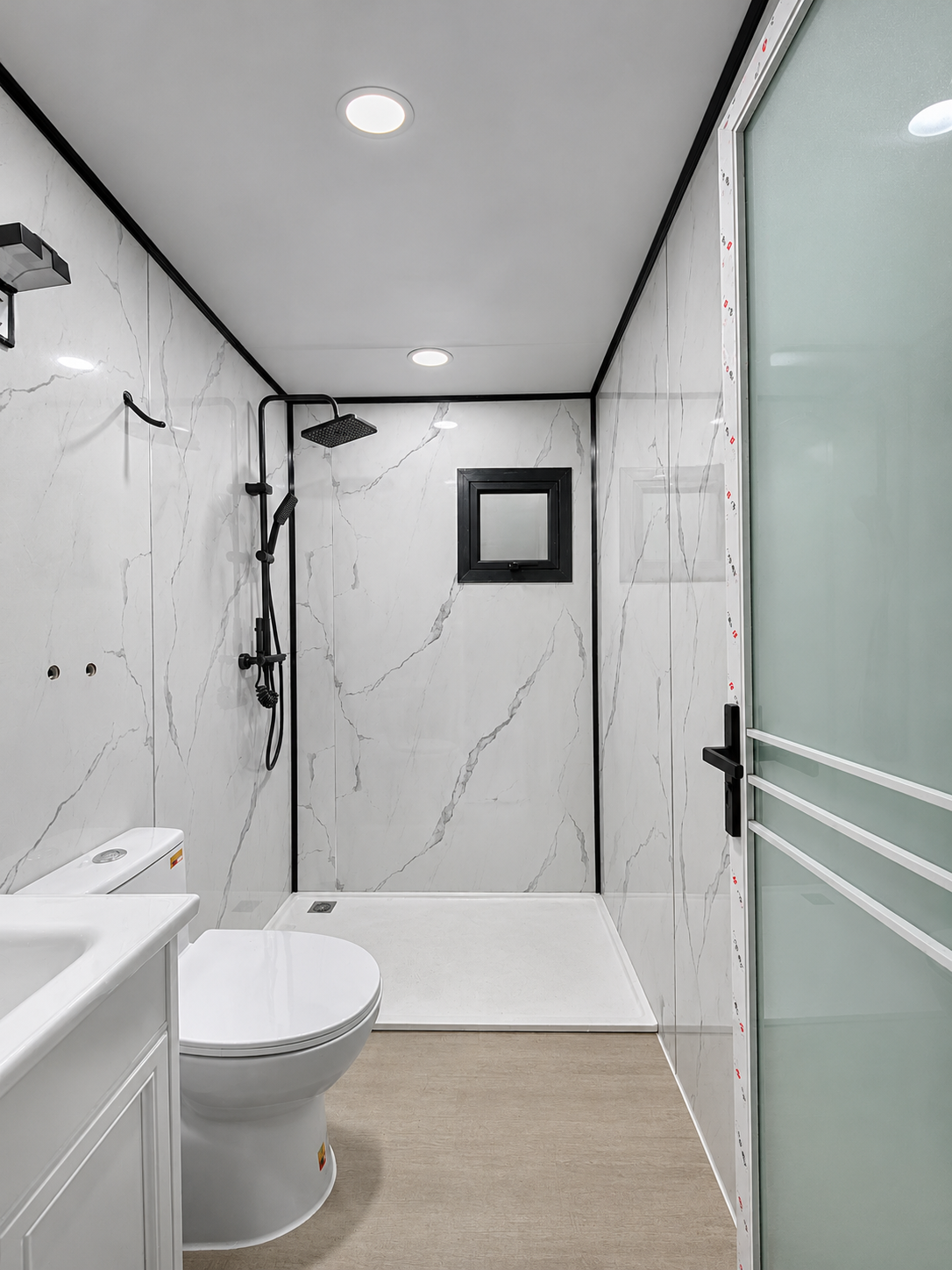
Methodology note: This article is an editorial technical review drawing on original analytical frameworks developed by Pengboxingchen Editorial. It is not a peer-reviewed academic paper. The photograph below shows a finished bathroom interior as a design reference; it is not a documented factory-built pod or a verified waterproofing installation. Project-specific waterproofing, drainage and structural decisions require qualified professional advice.
Abstract
Bathroom pods in modular hotel construction concentrate a high density of wet-area interfaces, drainage connections, MEP penetrations and finish elements within a compact volume. Coordination failures at these interfaces — between the pod structure and the module floor, between the drainage stack and the site drainage system, between the pod envelope and the room module — are potential coordination risks in modular hotel projects. This review presents an interface and failure-mode framework for bathroom pod coordination, with a focus on the evidence that buyers should request to verify waterproofing and drainage performance, and the access provisions that enable maintenance and remediation.
Keywords: bathroom pod, waterproofing, drainage coordination, interface management, failure modes, maintenance access
1. Scope and Approach
This review addresses bathroom pods as factory-manufactured units installed within modular hotel room modules. The analysis covers four interface zones: the pod-to-module floor interface, the drainage connection, the MEP penetrations through the pod envelope, and the pod-to-room finish interface. For each zone, the review identifies the primary failure modes, the evidence that should be available to verify performance, and the access provisions required for maintenance and remediation.
The framework is original to this review. It is not derived from a systematic review of failure data, which is not publicly available at the level of detail required. The failure modes identified are based on the authors' analysis of the interface conditions and are intended as a starting point for project-specific risk assessment, not a comprehensive failure catalogue.
2. Interface Zone 1: Pod-to-Module Floor
2.1 Interface Description
The bathroom pod sits on the module floor structure. The interface must transfer vertical loads from the pod to the module, accommodate differential movement between the pod and the module, and provide a continuous waterproof barrier at the perimeter of the pod base.
2.2 Primary Failure Modes
Potential failure modes to assess at this interface include: waterproofing membrane discontinuity at the pod perimeter, allowing water ingress to the module floor structure; differential settlement or deflection causing cracking of the waterproofing membrane or tile finish; and inadequate load transfer causing structural distress to the module floor.
2.3 Evidence to Request
Buyers should request: waterproofing specification and test evidence (flood test or equivalent) for the pod base and perimeter; structural calculation or test evidence confirming load transfer capacity; and inspection records confirming membrane continuity before pod installation.
3. Interface Zone 2: Drainage Connection
3.1 Interface Description
The pod drainage connects to the module drainage stack, which in turn connects to the building drainage system at site. The connection must be watertight, correctly graded, and accessible for inspection and clearance.
3.2 Primary Failure Modes
The primary failure modes are: leaking joints at the pod-to-stack connection; incorrect gradient causing slow drainage or blockage; and inaccessible connections that cannot be inspected or cleared without significant disruption.
3.3 Evidence to Request
Buyers should request: drainage layout drawings showing gradients and connection points; pressure test or flow test records for the drainage system; and confirmation of access provision for all joints and cleanout points.
4. Interface Zone 3: MEP Penetrations
4.1 Interface Description
Services entering and leaving the pod — water supply, waste, electrical, ventilation — penetrate the pod envelope. Each penetration is a potential point of water ingress, air leakage or acoustic flanking.
4.2 Primary Failure Modes
The primary failure modes are: inadequate sealing of penetrations allowing water ingress or air leakage; acoustic flanking through penetrations degrading room acoustic performance; and service connections that cannot be isolated or disconnected without removing the pod.
4.3 Evidence to Request
Buyers should request: penetration sealing specification and inspection records; confirmation that all services can be isolated at accessible points; and acoustic treatment specification for penetrations where acoustic performance is a requirement.
5. Interface Zone 4: Pod-to-Room Finish
5.1 Interface Description
The visible junction between the bathroom pod and the room finish — floor, wall and ceiling — must be watertight, dimensionally consistent and aesthetically acceptable. This junction is often the most visible evidence of pod installation quality.
5.2 Primary Failure Modes
The primary failure modes are: dimensional variation between pod and room module causing inconsistent junction gaps; inadequate sealing of the junction allowing moisture migration; and finish cracking at the junction due to differential movement.
5.3 Evidence to Request
Buyers should request: dimensional tolerance specification for the pod and module, and confirmation that the junction detail accommodates the specified tolerance; sealing specification and inspection records for the junction; and movement joint provision where differential movement is anticipated.
6. Interface and Failure-Mode Summary Matrix
| Interface Zone | Primary Failure Mode | Evidence to Request | Access Requirement |
|---|---|---|---|
| Pod-to-module floor | Waterproofing discontinuity; differential settlement | Flood test records; structural calculation; membrane inspection records | Perimeter inspection access before pod installation |
| Drainage connection | Leaking joints; incorrect gradient; inaccessible connections | Drainage layout drawings; pressure/flow test records; access confirmation | Access to specified inspection and maintenance points; stack inspection access |
| MEP penetrations | Water ingress; acoustic flanking; non-isolatable services | Penetration sealing spec; isolation point confirmation; acoustic treatment spec | Service isolation points accessible without pod removal |
| Pod-to-room finish | Dimensional variation; moisture migration; finish cracking | Tolerance specification; sealing spec; movement joint provision | Junction inspection access; remediation without full pod removal |
7. Distinguishing Finish References from Waterproofing Evidence
A common source of confusion in bathroom pod procurement is the conflation of finish quality with waterproofing performance. A high-quality finish — well-laid tiles, consistent grout lines, clean junctions — is evidence of good workmanship, but it is not evidence of waterproofing performance. Waterproofing performance must be demonstrated by test evidence appropriate to the system — membrane watertightness assessment, drainage flow testing, or other methods suited to the specific system, manufacturer requirements and applicable local requirements — conducted before finishes are applied and documented with inspection records. The test method, sequence and acceptance criteria must be specified by the responsible designer; membrane watertightness assessment and pipe pressure testing are distinct activities and should not be treated as interchangeable.
Buyers should be cautious of suppliers who offer finish photographs as evidence of waterproofing quality. The photograph at the top of this article shows a well-finished bathroom interior; it tells us nothing about the waterproofing membrane beneath the tiles, the drainage gradient, or the sealing of service penetrations. These must be verified by test evidence, not visual inspection of the finished surface.
8. Limitations and Project-Specific Verification
The failure modes and evidence requirements identified in this review are based on the authors' analysis of the interface conditions. They are not derived from a systematic review of failure data, and they may not be comprehensive for all project types, pod configurations or regulatory contexts. The framework should be adapted by the project team — including the structural engineer, waterproofing specialist and building services engineer — to reflect the specific conditions of each project.
Conclusion
Bathroom pod coordination in modular hotel projects requires systematic attention to four interface zones: pod-to-module floor, drainage connection, MEP penetrations, and pod-to-room finish. For each zone, the key discipline is to distinguish the evidence required to verify performance from the visual indicators of finish quality. Waterproofing, drainage and service isolation must be verified by test evidence and inspection records, not by visual inspection of the completed finish.
References and Further Reading
The following sources are cited in or provide relevant background to this article. Where a source supports a specific assertion, that is noted inline. Sources listed as further reading provide relevant context but are not cited for specific claims in this article.
- Further reading: UK Government, Volumetric Modular Construction Research, published 26 November 2024 (research finalised July 2022, England scope). gov.uk — provides context on pre-project planning and lifecycle interface ownership in modular construction outcomes.
- Further reading: AIA–NIBS, Modular and Off-Site Construction Guide (2019). nibs.org — industry guide covering off-site construction coordination principles.
This editorial review has not undertaken a systematic failure-data study. Statements about coordination risks reflect the analytical framework presented here, not a survey of industry failure records.
For information about bathroom pod products and the coordination documentation available, see our bathroom pods product page or contact us. Related reading: MEP Interface Coordination and Factory Quality Records for Modular Buyers.
Topics
Explore our modular room products
Ready to discuss your project?
Our team is available to answer technical questions and provide indicative pricing for your modular construction project.
Contact Us